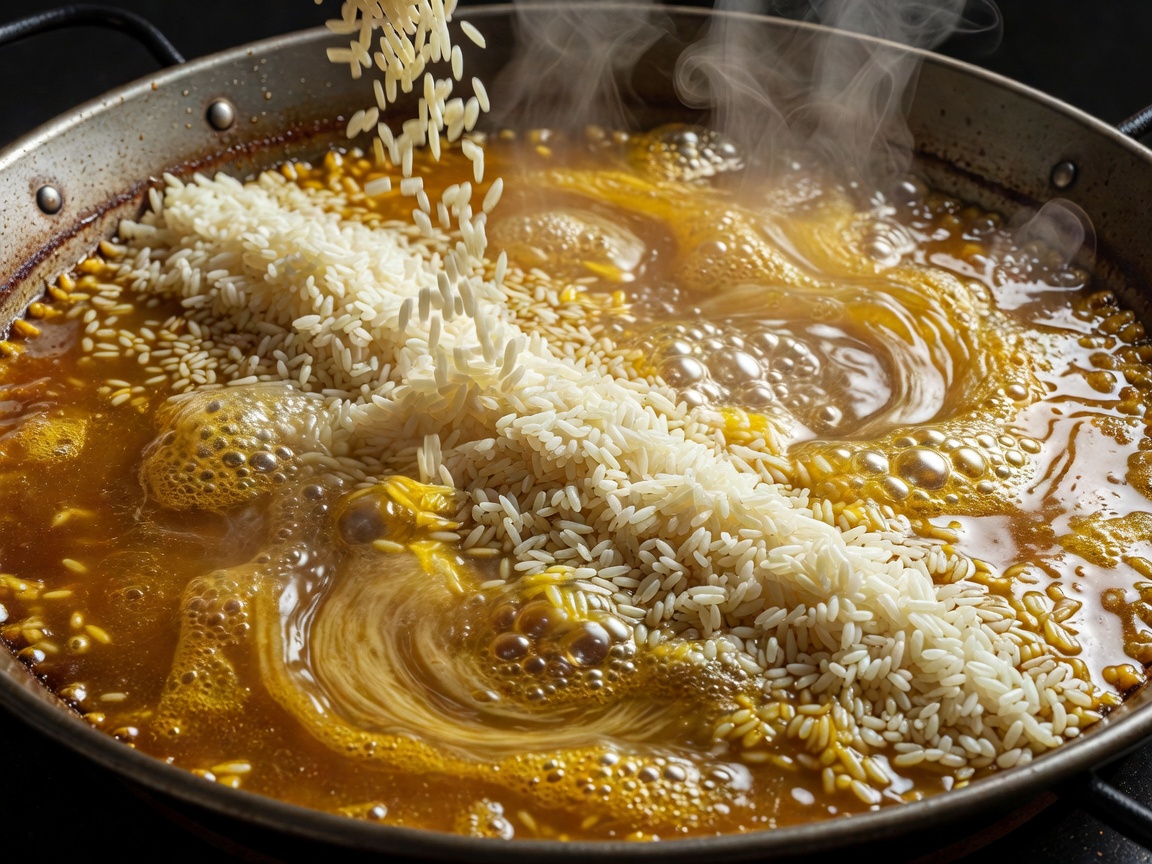
The Ridge Technique (En Caballó or En Cruz)
Once your broth has reduced to the target level and tastes properly seasoned, do not dump the rice randomly. Valencian cooks distribute rice using one of two geometric methods:
- El Caballó (The Ridge): Pour the dry, unwashed rice in a straight line from one edge of the pan through the center to the opposite edge. The crest of this dry rice mound should peak roughly 1 to 2 centimeters above the broth surface. This visual indicator confirms that your ratio of grain to liquid is physically balanced.
- En Cruz (The Cross): For large pans over 50 cm, rice is poured in two perpendicular crossing lines, quartering the pan into equal zones.
Using a wide wooden paddle, gently sweep the rice out from the center ridge toward the edges until every grain is submerged beneath the boiling broth. Reposition meat and bean pieces so they are evenly scattered. You now have 60 seconds of gentle manipulation. Once that minute expires, your paddle must not touch the pan again.
The Science: Why You Must Never Stir Paella
To understand why stirring is forbidden in paella yet mandatory in risotto, examine the starch polymers within rice kernels:
| Cooking Method |
Desired Texture |
Role of Starch |
Mechanical Agitation Effect |
| Risotto (Italian) |
All'onda (creamy, viscous, fluid suspension) |
Surface amylopectin is rubbed off into warm stock to emulsify fat and wine. |
Continuous stirring is mandatory to scrape off starch molecules and build creaminess. |
| Paella (Valencian) |
Seco y suelto (dry, discrete grains with distinct bite) |
Starch must gelatinize inside the swollen grain without escaping into the broth. |
Stirring ruptures grain membranes, washes free amylose into liquid, and yields gummy glop. |
Short-grain rice contains two main starch components: straight-chain amylose and branched-chain amylopectin. During cooking, water penetrates the grain, causing starch granules to swell and hydrate (gelatinization).
If you stir the grains while they are swelling, the mechanical friction between kernels shears the fragile outer cell walls. This releases viscous amylose directly into the boiling broth. The liquid thickens into a pasty slurry, which prevents the remaining steam from escaping. Consequently, the rice becomes gummy (empastrado), fails to dry out, and can never produce a crisp socarrat crust.
The 18-Minute Chronology
Authentic paella is cooked according to a rigid thermal schedule:
- Minutes 1–8 (Furious Boil): Full heat across all rings. The broth bubbles violently, rolling the grains across the floor of the pan so they absorb liquid evenly before settling.
- Minutes 9–14 (Gentle Simmer): Reduce heat to medium-low. The grain tips begin breaking through the surface of the evaporating liquid. The rice begins setting into a static matrix.
- Minutes 15–18 (The Dry Finish): Broth has completely vanished from sight. Low heat across all burners gently dries residual moisture from the deep center.
What If You Notice an Uneven Dry Spot?
If a breeze from your patio or an uneven flame causes one quadrant of the pan to dry faster than the other, do not stir. Instead, either rotate the entire paella pan 90 degrees on the burner, or gently spoon two tablespoons of hot water onto that dry quadrant. Let the heat do the work.